

Parliamentary Counsel Office
Exploring how AI tools can help produce accessible legislation
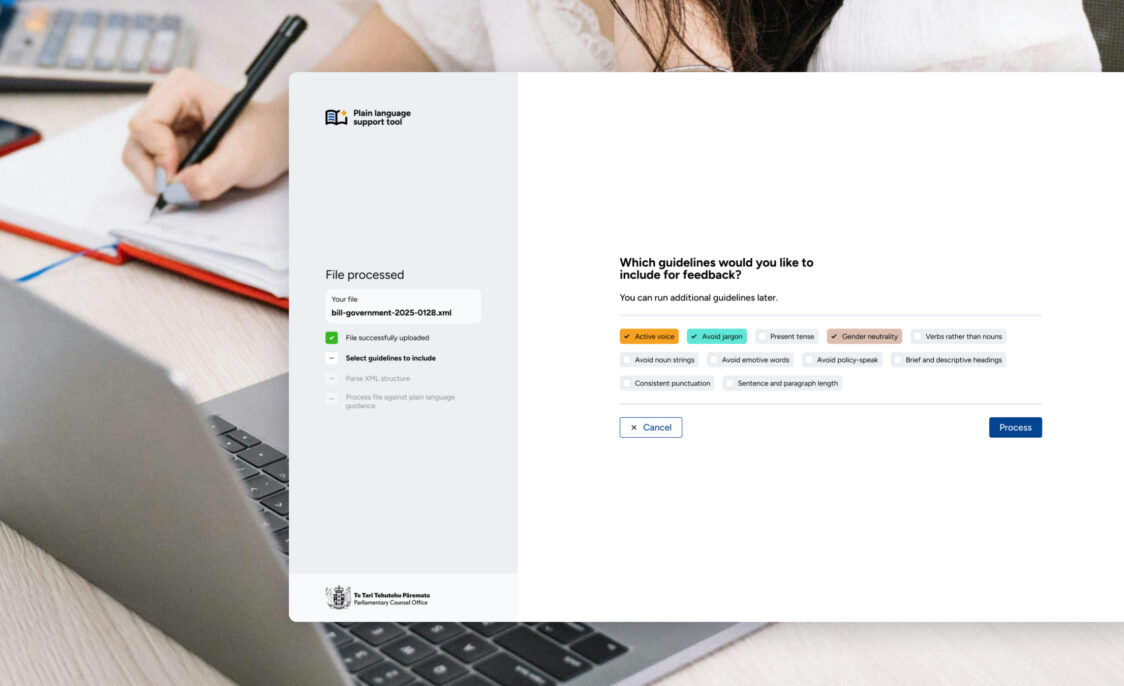
We engaged with the Parliamentary Counsel Office to face the challenge of how AI can support legislative drafters with plain language suggestions to improve accessibility.
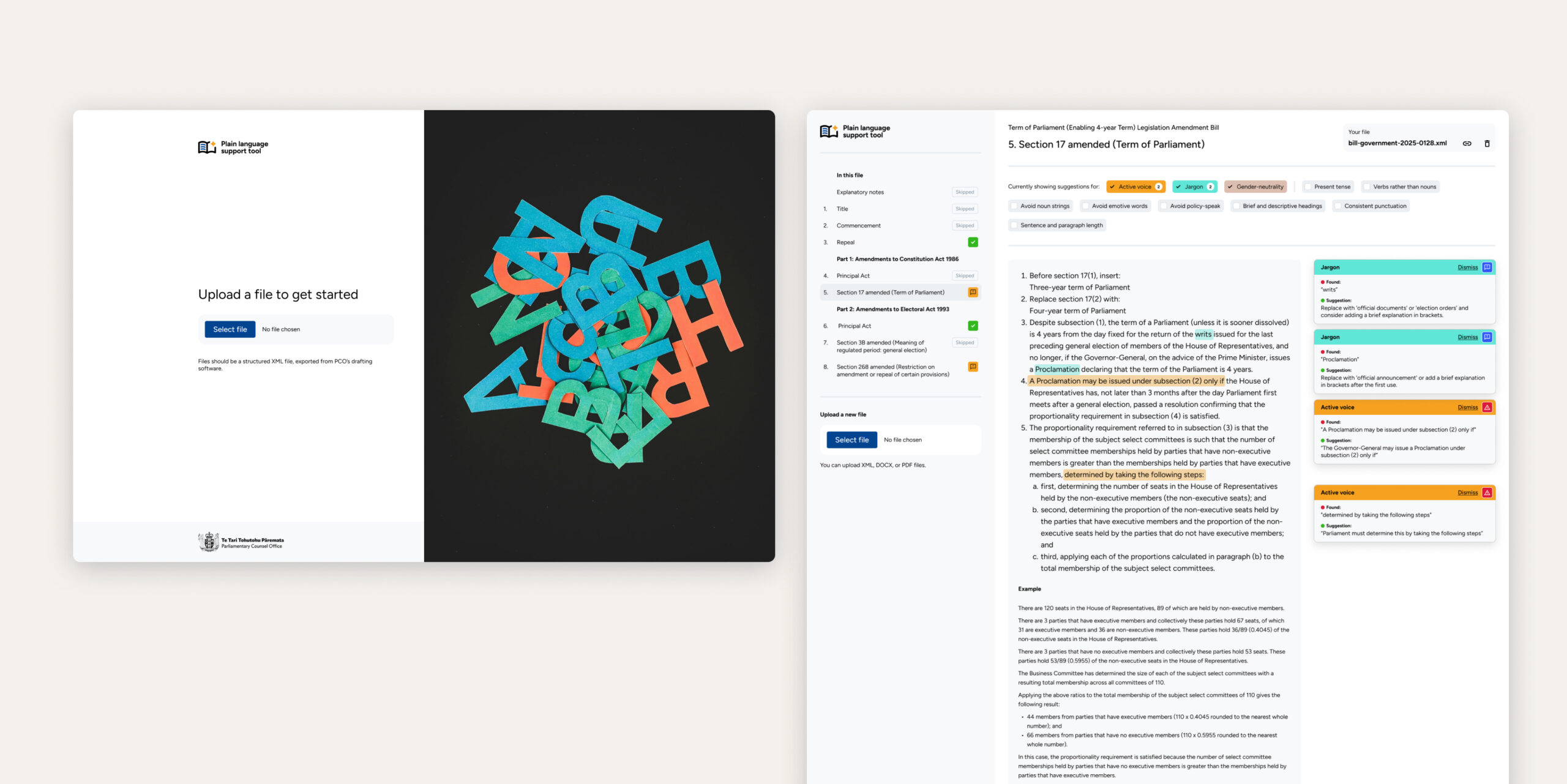
Our solution was led by user testing, research and discovery to develop prototypes informed by PCO’s plain language guidelines. The Ackama team prototyped several plain language suggestion tools including integration into organisational processes and software, with user research and open-source outputs.
Partnering on innovation in plain language law
The Parliamentary Counsel Office (PCO) drafts all legislation for Aotearoa New Zealand. PCO are already leading the way in Plain Language adoption and has produced its own set of Plain Language guidance.
With a long-standing commitment to plain language and an interest in the role AI might play in that future, they engaged Ackama to explore a research and development opportunity. The goal: could technology assist drafters in making legislation more accessible, without compromising its legal integrity?
This was more than a technical challenge. For PCO, it was about maintaining trust in the law, ensuring that everyday people can understand the rules that govern their lives. We were selected to lead the plain language stream of their Legislative Data and Technology R&D program, applying AI to support legislative drafting in a way that strengthens clarity and comprehension.
Designing a tool grounded in law, built for people
Our discovery process began with workshops alongside expert drafters, followed by iterative prototyping and user testing.
Drawing from PCO’s existing plain language guide, we transformed those standards into a machine-readable format that could guide AI-generated suggestions. The key was consistency with PCO’s voice and legal rigour. This wasn’t about simplifying for the sake of it, but about empowering clarity where it counts most.
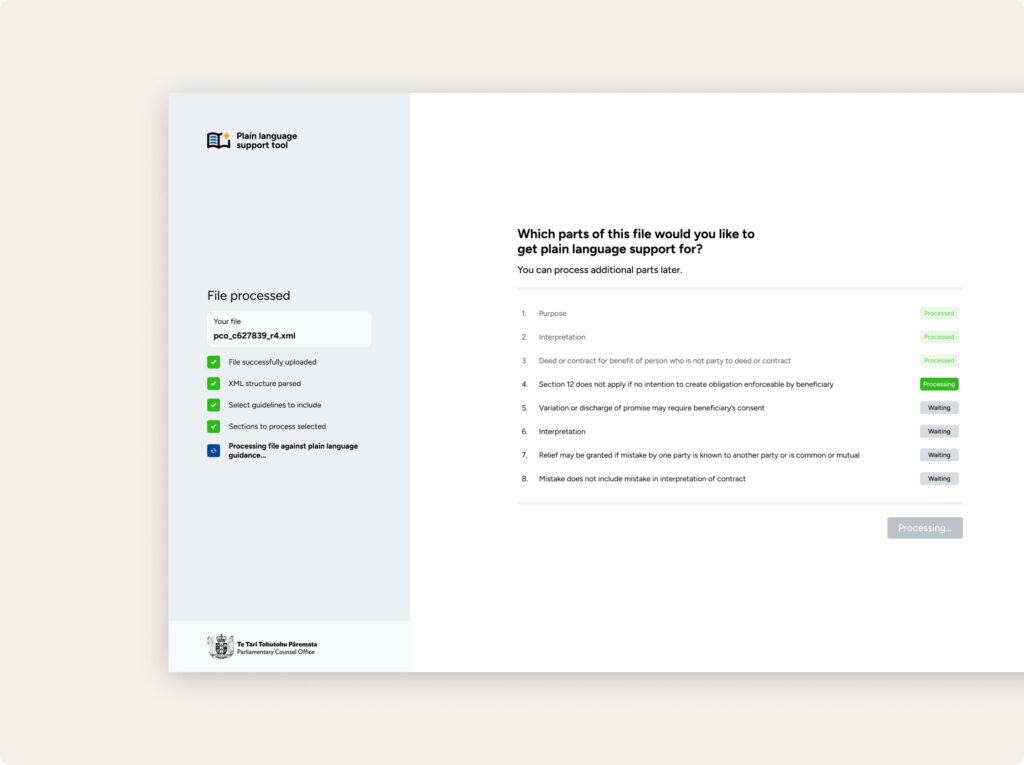
We used modern tooling to build the prototype, including Figma, Next.js, Amazon Web Services and a range of large language models, to ensure performance, flexibility, and data sovereignty. Most importantly, we kept users at the centre of every design decision. The result was a tool built to support drafters in their work while integrating with their existing processes.
Building the foundation for smarter, fairer lawmaking
This project’s outcome was a functional, open-source, prototype that validated both the concept and the technology behind it. But its real value lies in what it could mean long term: a future where legislation is easier to understand, not just for trained experts but for communities, advocates, and everyday citizens.
In a time where trust in institutions matters more than ever, making the law more accessible isn’t just a technical win, it’s more broadly felt than that. By embedding plain language into the drafting process, this work supports a legal system that is clearer, fairer, and more inclusive.
You can read more about the project on PCO’s website or please get in touch with one of our team.